

Poem: Beyond the Sea
On shape, rhythm, and letting a poem find its own structure

Some poems arrive knowing what they are. They have a shape before you have a title, a rhythm before you have more than a handful of lines. Others resist that. They come quickly - the words appear, the poem is there - but they never quite settle into a single form. They move between things instead.
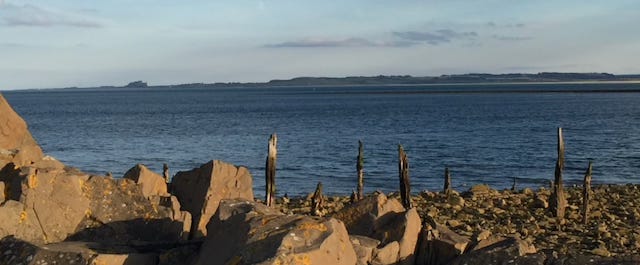
Beyond the Sea is one of the latter. I’ve written elsewhere about where it came from, and I won’t revisit that here. What I want to look at now is how it works - or rather, how it doesn’t quite follow the rules of any one approach.

Beyond the Sea
Somewhere,
Beyond the sailing ships
There is a land where I will fit.Beyond the sea -
Its storm-fuelled waves
With foam-white tops -
That dash poor souls,
Like me,
Upon the rocksI see the peace
Of this new land.
Of barefoot feet
On golden sand
Of cloudless skies
And warming breeze;
The welcome shade
Of broad-brimmed treesBeyond the sea
There is a land
That beckons me.
The journey will be hell
And none can take my hand
To guide me through the swell.It is my choice
And mine, alone.
I’ll be at peace
When I am gone.
A poem with no single form
There is no consistent rhyme scheme here. There is no fixed metre. But it is not quite free verse either; there are moments where rhyme appears, where lines pair up and echo each other, before the pattern dissolves again.
By which I mean: the poem keeps brushing against structure without committing to one. It is something in between. Maybe that is exactly what this poem needed to be - neither fixed nor formless.
How the rhythm shifts
Read it aloud, or just run it through your head, and you will notice the pace changing.
The longer lines - The journey will be hell / And none can take my hand / To guide me through the swell - carry more weight. They slow things down, pull you through the thought. The shorter lines do the opposite. Like me sits alone on its own line. Upon the rocks lands hard. The brevity is the emphasis.
That variation is not accidental. The rhythm mirrors something about how the poem moves emotionally - from description to something more immediate and stark.
Line breaks and what they do
Some lines feel complete. There is a land where I will fit. You can stop there. Others feel cut - suspended mid-thought, pushed to the next line before they finish.
That fragmentation matters. It creates pause. It isolates. A short line draws the eye and the breath. Like me means more because it stands alone than it would buried in the middle of a longer line.
The visual shape of the poem on the page is part of how you experience it.
Holding different modes together
The poem does not stay in one register. It moves between them.
The third stanza is descriptive - almost peaceful, a sequence of images: golden sand, cloudless skies, shade. The fourth shifts into something more direct. The fifth is stark declaration. It is my choice / And mine, alone.
Those are different kinds of writing, sitting in the same poem. Descriptive, then reflective, then blunt. The voice does not stay consistent - and that unevenness, I think, is part of what makes the poem feel the way it does.
Maybe that is not incidental. A poem written from a fractured or unsettled place might resist the tidiness of a single form - not because the writer chose disorder, but because disorder was closer to the truth of what they were feeling. The shifting registers, the inconsistent structure, the way the poem lurches between the serene and the stark: these could be read as marks of craft. Or they could be something else - a record of the mind that made them.
Letting it be uneven
I could have tidied this up. Chosen a form and shaped the whole poem toward it - fixed the rhyme scheme, evened out the metre, smoothed the shifts between stanzas.
I am not sure it would have been better. Some things are more honest when they are uneven. The roughness carries something that polish might remove.
Not every poem is shaped in advance. Some take the shape of what they are trying to say as they go. I think that is what happened here.
The structure of Beyond the Sea is not a single chosen form. It is a series of small decisions - a pause here, a short line there, a stanza that rhymes when it wants to and doesn’t when it does not. Whether that adds up to something coherent is, as always, for you to judge.
I’d love to hear what you think in the comments.