

The Analog Comeback
On what the notebook does that the laptop can't

When I close the laptop and pick up the pen, something shifts. There’s a change of pace and thinking. What I write is different; less finished, more honest.
The Return of the Physical
Bookshops are full again, vinyl outsells CDs. And film cameras are back - not in a retro, kitsch way, but in the hands of people who want the experience of taking a photograph to mean something.
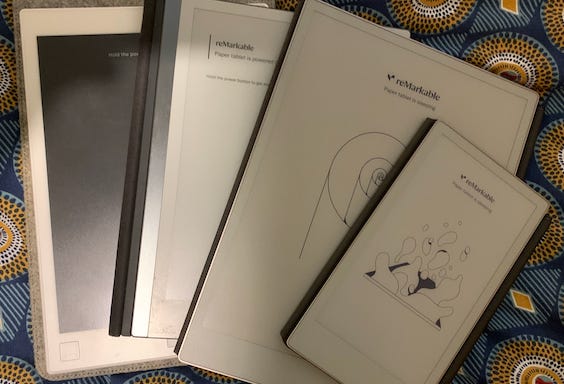
The reMarkable exists because its founders knew, correctly, that a significant number of people would pay a premium for a screen that feels like paper.
Rather than being nostalgic, this is reaching for something different – a different quality of attention.
This piece by 1000 Libraries discusses the Japanese concept of shinrin-yoku – forest bathing, the restorative effect of immersing yourself in a natural environment – and offers a useful way to map it. We built the modern world to reflect the way our brains work at speed. The analog world reflects how our brains work when they’re given time. That version of ourselves hasn’t gone anywhere; it still craves the physical. Right now, that craving is getting louder.
Analog and the Writing Life
Writing by hand - or on the reMarkable, which is where most of my notes and early drafts begin - slows the thinking down. That might sound like a disadvantage, but the slowness is where a lot of the actual thinking happens.
Typing is fast enough to outrun the idea. You can fill a page with words before you’ve decided what you mean. Writing by hand forces you to commit earlier. Each sentence has its place because writing another one costs something.
The friction is important in another way too. When I make an error, I cross it out. The crossing-out stays visible. There’s a record of the thinking, not just the thought. That’s gone the second you hit delete on a keyboard.
My reMarkable is where I create. Scrivener is where I edit. Ideas that migrate from reMarkable to Scrivener arrive more considered; less reactive. They’ve had time to settle before I start arranging them for the reader.
There’s a neurological explanation for why this matters - Why Your Brain Loves Physical Books goes into the detail of what’s happening when you switch from screen to page.

The Case for Switching
I’m not advocating for a pre-digital age - this blog exists online, the reMarkable syncs to the cloud. I’m not opting out of anything.
But in the digital world there is pressure to produce, to publish, to respond, to keep pace. It grabs attention in a particular direction - outward, forward, toward the next thing.
The analog world asks nothing of us. The notebook sits on the desk and waits. There is no metric updating in the background. No notification. No signal that something is happening elsewhere that you should probably know about.
But it’s not a case of one or the other, it’s about the different advantages of each, knowing when to switch, and being willing to make that switch when the thinking needs it.
Analog as Practice
Choosing analog isn’t a rejection of modernity. It’s choosing a different tempo for a portion of your time. A breath, taken deliberately.
For writers, or for anyone who makes things by thinking, the choice has a practical dimension as well as a philosophical one. Analog isn’t a preference. It’s a practice. A way of protecting the quality of the thinking before it becomes the work.
The notebook offers a human way of thinking in an increasingly inhuman world. Unoptimised. Untracked. That’s something to preserve.
If the wider argument interests you - reading and writing as deliberate acts against digital noise - Reading as Resistance picks it up from a different angle.

I’m curious whether you experience this – the shift that comes from switching away from the screen.
Do you write by hand? Do you notice a difference when you do? Is there a tool or a ritual that helps you slow the thinking down before it becomes the writing?
Let me know in the comments. I read every one.